Skip to content

Outdoor water filters, compared on what each maker declares

This page reports what each maker declares about its own filter — the micron figure it publishes, the litres it claims for a cartridge, and the format it comes in. Questions about whether any particular water is safe to drink belong to the maker's instructions and to the local authorities, not to a comparison page.

A note before the comparison, and it governs everything below. This page reports what each manufacturer declares about its own product: the pore size it publishes, the litres it claims, the format it sells. It does not say that any filter makes any water safe to drink, and it does not say the opposite either. Whether a given source can be used is a matter for the maker’s own instructions and for the authorities responsible for that water, and it is decided at the source, not on a comparison page.

With that stated plainly, three published figures separate these filters, and two important ones are missing from every listing in the family.

Pore size, as each maker publishes it

Micron figures on this shelf fall into three bands, and the band is more informative than the decimal place.

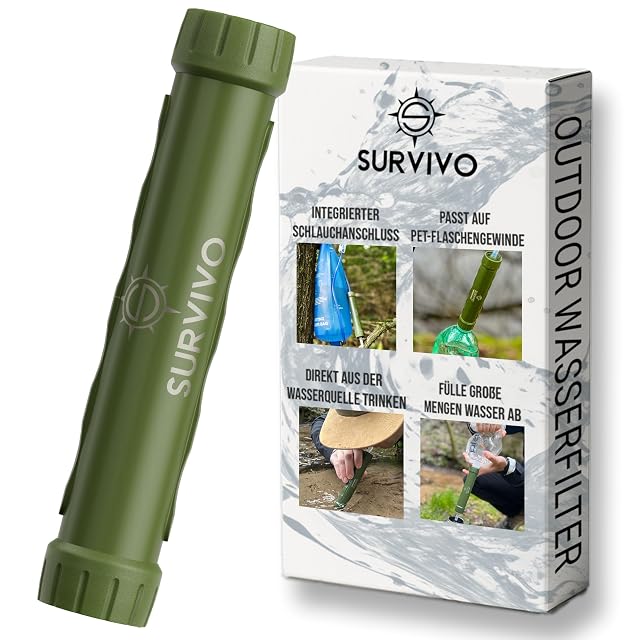
0.01 micron is declared by Purewell, which states it twice — as 0.01 μm in its title and as a filtration accuracy of 0.01 micrometre in its bullets — and by SURVIVO, which also states it twice, once as 0.01 micrometre and once as 0.01 µm. A figure printed twice in two forms is a maker committing to it rather than dropping it into a title.

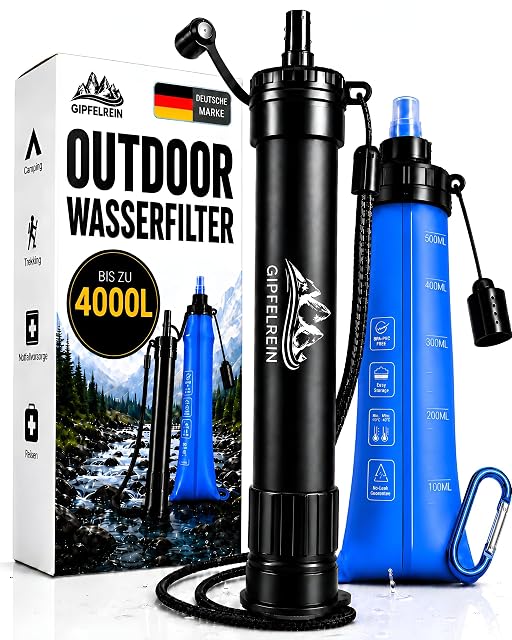
0.1 micron is declared by Waterdrop, as a 0.1 µm ultrafiltration membrane, and by Gipfelrein, as a pore size of 0.1 µm.

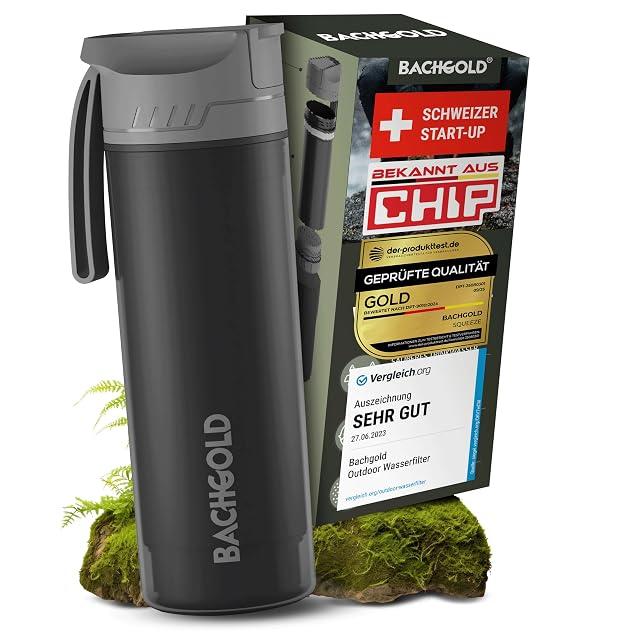
0.2 micron is declared by BACHGOLD, as a filtration accuracy of up to 0.2 µm.

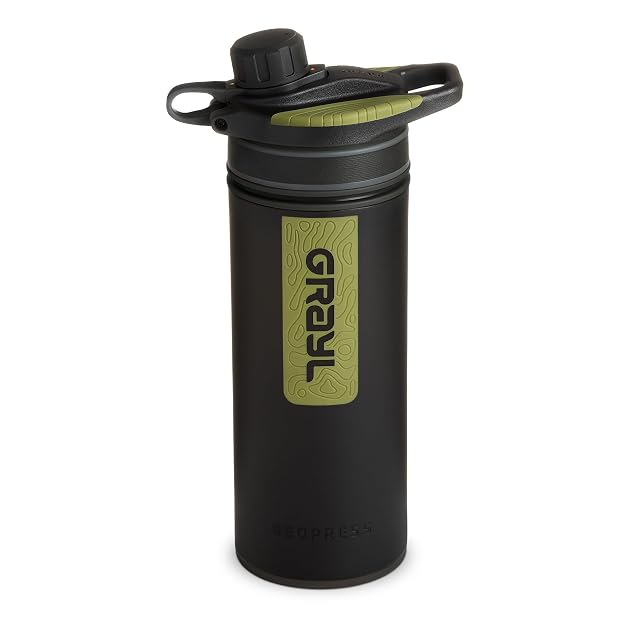
And two of these publish no micron figure at all. The GRAYL publishes a replaceable press-through cartridge and does not name the media inside it. The RIF. names its medium — KDF-55, which the maker describes as removing heavy metals and chlorine — and publishes no pore size. Both are telling you something real and neither is telling you the same thing as the others.

Cartridge life, and the running cost behind it

Every filter here is a consumable with a body attached, and the stated litres are how the maker expects that consumable to be budgeted.

Waterdrop states up to 5300 litres. SURVIVO states up to 4000, in its title and again in its bullets, and RIF. states 4000 in its title. BACHGOLD and Purewell both state 1500. Gipfelrein states up to 4000 for its hollow-fibre membrane.

The GRAYL states 250 litres for its replaceable cartridge, which is an order of magnitude below the rest and is not a defect: it is a different product design, in which the cartridge is expected to be replaced as a routine cost rather than to last the life of the bottle. Read it as a subscription rather than as a shortfall, and price the replacements before ordering.

Format, which decides whether you use it

This is where the real choice sits, because the filter you use every day is the one that suits how you actually drink.

A press bottle treats a fixed volume at a time. BACHGOLD is an all-in-one press-through bottle of 500 ml, stated to need no additional components. GRAYL treats 710 ml at a time — fill, press, drink, with no pumping, batteries or chemicals. OUTDOOR-FRIENDS, elsewhere on this site, is a press bottle with a magnetic lid whose volume is never published.

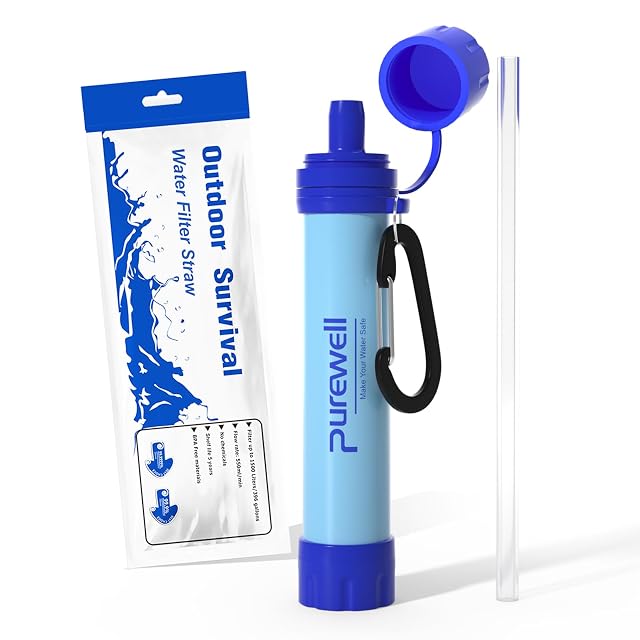
A straw is the lightest thing to carry and the most awkward to drink from at a stream. Purewell is a straw with a carabiner, stated to be drawn through at the source or fitted into a water bottle, and it names all four of its stages: a hollow-fibre ultrafiltration membrane, PP cotton, coconut-shell activated carbon and an adsorption ball. That is more detail on the element than anything else on this page gives.

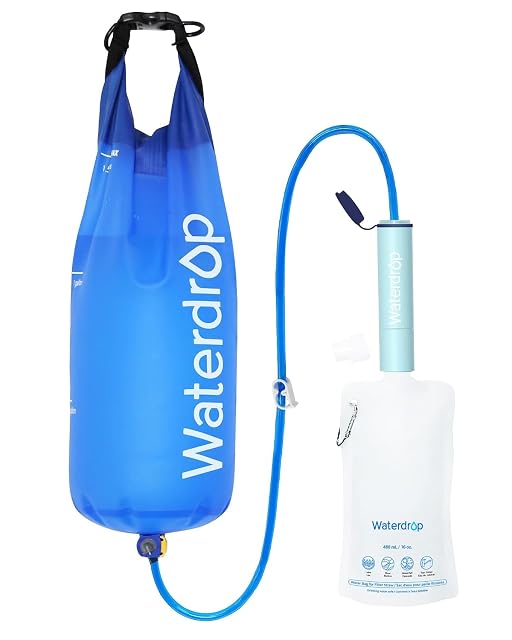
A gravity set does the work while you do something else. Waterdrop supplies a straw with a gravity water bag, states that both ends come apart, and states that it works with bags or bottles. For a camp where a bag can be hung on a branch and left to run, that is a different daily rhythm from squeezing a bottle.

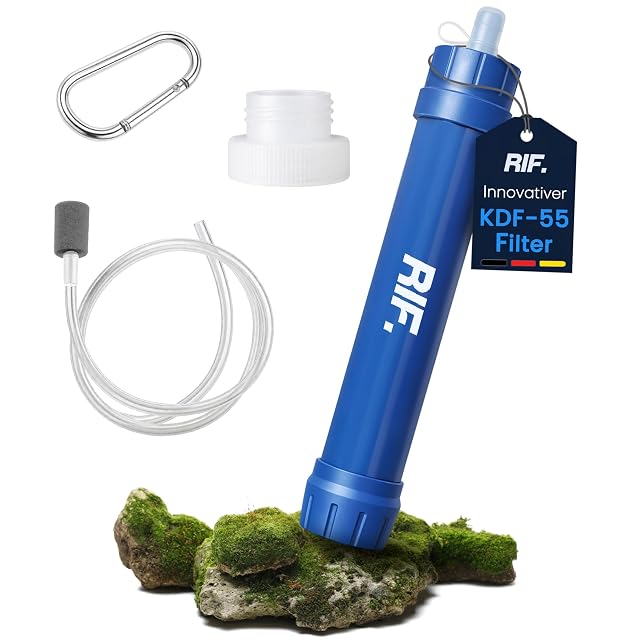
An in-line or bottle-mounted filter joins kit you already own. SURVIVO states a standardised thread for commercially available PET bottles and states that it connects to water bags and drinking systems, which makes it the natural pairing for a hydration reservoir. RIF. states a universal adapter said to fit almost all common bottle sizes. Neither publishes a thread size in millimetres, so “universal” is the maker’s word rather than a measurement you can check.

A filter with its own bottle is the compact set. Gipfelrein supplies a screw-on filter with a foldable 0.5 litre bottle, a lanyard and a carabiner.

The two figures nobody publishes

Not one filter on this site publishes a flow rate, and not one publishes a weight.

Flow rate is what separates a filter you top up from a filter you resent. A straw drawn through a loading membrane and a gravity bag hung on a branch are very different experiences of the same stated pore size, and no listing here quantifies the difference.

Weight matters for the same reason it matters everywhere else on this site: a press bottle with a cartridge inside it is a heavier object than a straw, and none of these listings will tell you by how much. If it is going in a pack, weigh it when it arrives.

Backflushing and maintenance

The one maintenance detail published here comes from Waterdrop, which states that its filter is backflushed without a syringe. Every hollow-fibre element slows as it loads, and how it is cleared is the difference between a filter that lasts its stated litres and one that gets left at home. Where a listing does not describe the procedure, the instructions in the box are the place to look before the first trip rather than during it.

Choosing between them

If a bag can be hung at camp, the Waterdrop set states more litres per cartridge than anything else on this page, and adds a straw for use at the source. If a straw carried as a backup is the plan, Purewell names every stage of its element. If you already run a hydration reservoir, SURVIVO goes into the line. If you already carry a bottle you like, RIF. adapts to it. If one small bottle refilled at the stream is the whole water plan, BACHGOLD or Gipfelrein do that in one object. And if you would rather treat a fixed volume and replace the cartridge on a schedule, the GRAYL is built around that habit.

Whichever you choose, the notice in the box is the document that governs its use, and local guidance governs the water.
What we would carry, and why

  1. Waterdrop straw filter with gravity bag, 0.1 micron stated, 5300 litre cartridge

    Straw with gravity bag · 0.1 micron stated · carbon and UF membrane · 5300 litre cartridge · backflush without a syringe

    A straw filter sold with a gravity bag, publishing a 0.1 micron pore size, a 5300 litre cartridge life and — unusually for this shelf — a stated way of restoring flow without carrying a separate syringe.

    Best for: A camp where a bag can be hung and left to run, with the straw doubling as a direct drink at the source.

    ≈ £28 / 28 €

  2. Purewell straw filter, 0.01 micron stated, 1500 litre cartridge

    Straw filter · 0.01 micron stated · four named stages · 1500 litre cartridge · carabiner

    A straw filter that publishes both of the figures this shelf usually splits — a 0.01 micron rating and a 1500 litre cartridge life — and names all four stages of its element, while saying nothing about flow, weight or the thread it screws onto.

    Best for: A pack where a straw is carried as a backup and the cartridge figure matters more than the handling.

    ≈ 15 €

  3. SURVIVO in-line filter for PET threads and reservoirs, 0.01 micron stated

    In-line filter · 0.01 micron stated · carbon and UF membrane · 4000 litre cartridge · standardised PET thread

    The one filter on this shelf that treats compatibility as a specification: a standardised PET bottle thread and a stated connection to hydration reservoirs, alongside a 0.01 micron pore size and a 4000 litre cartridge life.

    Best for: Someone who already runs a hydration reservoir and wants the filter in the line rather than a second vessel.

    ≈ 30 €

  4. Gipfelrein screw-on filter with 0.5 litre foldable bottle, 0.1 micron stated

    Filter and bottle set · 0.1 micron stated · hollow-fibre membrane · 4000 litre cartridge · 0.5 L bottle

    A hollow-fibre filter sold with the bottle it screws onto, publishing both a 0.1 micron pore size and a 4000 litre cartridge life — and, because the bottle comes in the box, never needing to say what thread the filter takes.

    Best for: A day walk where the water is refilled often and the whole set can live in a hip pocket.

    ≈ £30 / 25 €

  5. BACHGOLD press-through 500 ml bottle, 0.2 micron stated, 1500 litre cartridge

    Press filter bottle · 500 ml · 0.2 micron stated · hollow fibre with carbon · 1500 litre cartridge

    A 500 ml press bottle that publishes volume, pore size, element type and cartridge life — four of the seven columns this hub compares — and quotes the coarsest micron figure of the six filters here that give one.

    Best for: A short walk or a run where one small bottle refilled at the stream is the whole water plan.

    ≈ £40 / 60 €

  6. GRAYL GeoPress 710 ml press bottle, 250 litre cartridge

    Press bottle · 710 ml · 250 litre replaceable cartridge · no pore size published

    A 710 ml press bottle with a replaceable cartridge rated at 250 litres, and the most talkative claim list on this shelf — every one of which is written here as the maker’s claim, because no pore size is published to check any of it against.

    Best for: Travel where one bottle is treated at a time and the cartridge is expected to be replaced as a routine cost.

    ≈ £108 / 120 €

  7. RIF. bottle-mounted filter, KDF-55 medium, 4000 litre cartridge

    Bottle-mounted filter · KDF-55 medium stated · 4000 litre cartridge · universal bottle adapter

    A bottle-mounted filter that names its medium and quotes a 4000 litre cartridge life, then leaves out the pore size entirely — the figure that would say what that medium is built to hold back.

    Best for: Someone who already carries a bottle and wants a filter that adapts to it rather than replacing it.

    ≈ 20 €

What people ask before buying

What does a micron figure describe?

The pore size the maker declares for the filter element, in micrometres. It is a statement about the medium, published by the manufacturer. What any given filter does to any given water source is a question for the maker's instructions and for the authorities responsible for that water.

Which of these publishes a flow rate?

None of them. Not one filter listed on this site publishes a flow rate in litres per minute, and not one publishes a weight. Those are the two figures that decide how a filter feels in daily use, and the whole family leaves them out.

How should I read a cartridge life figure?

As what the maker states the element is rated for, in litres, under its own assumptions. The stated figures here run from 250 litres on the GRAYL to 5300 on the Waterdrop, and a replaceable cartridge with a short stated life is a running cost to budget for rather than a fault.

Does a filter with an unnamed pore size tell you less?

It tells you something different. The GRAYL publishes a replaceable cartridge rated at 250 litres and does not name the media inside it; the RIF names its medium as KDF-55 and publishes no micron figure. Both are partial pictures, and both are worth knowing before ordering.

Prices in these summaries were read on the dates each review gives. The live figure sits beside every product.

The tool we use ourselves

Chosen your kit? Now buy it at the right price.

This is a summer category: demand for tents, sleeping bags and stoves is at its lowest in November and at its highest in July and August, and a price crossed out in the middle of that swing tells you nothing on its own. UniverTrack records what each retailer has actually been charging, so a reduction is measured against the price that really held rather than against one that never did, and alerts you when it is genuinely the moment to buy.

Real price historyBuy-now alertsAI buying assistant
Try free for 14 days →
No commitment · Cancel in one click · 5 languages