There are two ways to sleep out without a tent, and they fail differently.
A bivy bag puts a waterproof layer directly on your sleeping bag. It packs small, it needs no pitch, and every bit of moisture you produce has to leave through that layer or stay inside it. A tarp puts a sheet in the air above you. It is airy and versatile, it needs trees or poles and something to tie to, and it leaves your sides open to whatever the wind is doing.
Read the specification sheets and the difference is immediate: bivy listings publish waterproofing and breathability, tarp listings publish cut sizes and what is in the bag.
A water column is easy to publish and easy to understand. A breathability figure is neither, and it is the one that decides whether you wake up in a damp sleeping bag.
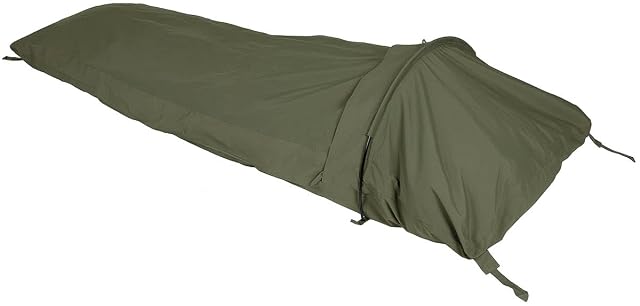
The MFH hooped bivy publishes both: a 10,000 mm water column and 3,000 mvp, from a three-layer laminate whose face fabric is not named. It also publishes a pitched size of 235 x 70 tapering to 95 cm with 45 cm of height, six ground attachment loops, mat loops for mats up to 60 cm wide, a side and head opening on a two-way zip, an integrated mosquito net, about 1.4 kg and a packed size of 35 x 13 x 13 cm. On this shelf that is close to a complete specification, and it is why it opens the list.
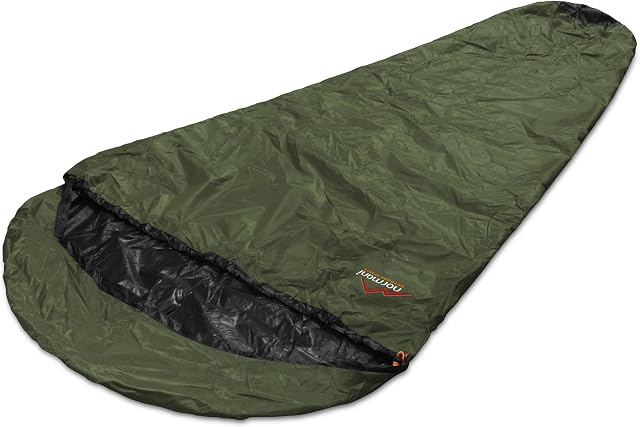
The normani cover publishes the same pair — 10,000 mm and 3,000 MVP — on a Diamond Ripstop polyamide, with welded seams, a right-hand zip, a 230 x 90 cm cut and a stated 397 g. It is the light option here, and it is a cover for a sleeping bag rather than a shelter of its own: no pole, no hoop.
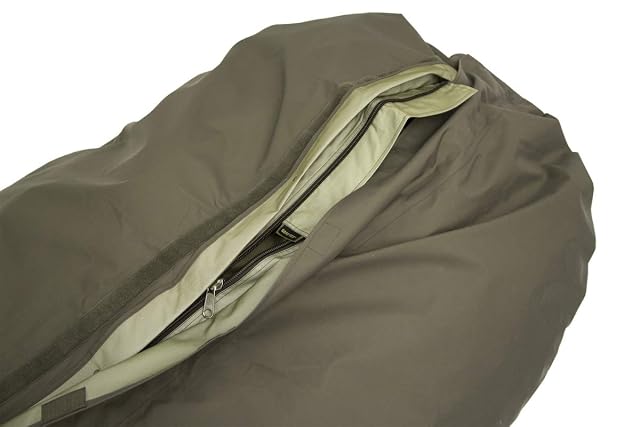
The Carinthia takes the other route. It names its material in full — three-layer Gore-Tex, polyamide face, PTFE membrane, polyamide lining — and publishes no water column and no breathability figure at all. What it does publish is size: 243 cm long with a 98 cm shoulder, which is a cut made for a bulky winter bag. The membrane name is what is being bought here, and the numbers are not on the page.
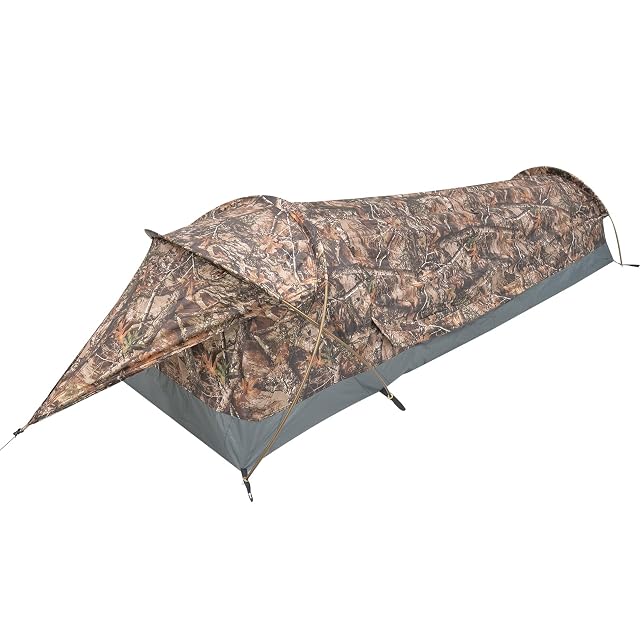
The GEERTOP is a different object again: a one-person shelter with two aluminium poles, a PU 5000 mm flysheet, fully sealed and double-stitched seams, 215 x 75 cm with 61 cm of head room, 45 x 13 x 13 cm packed, and approximately 1.3 kg stated for the complete set — labelled as the whole set rather than the canopy alone, which almost nothing else on this site troubles to say.
Where each bivy stops
None of these bivies publishes a denier. The Carinthia and the GEERTOP publish no breathability figure. The Carinthia publishes no weight and no packed size, so the two questions a walker asks first cannot be answered before it arrives.
That is worth knowing rather than resenting. A listing that names a membrane and gives you a 243 cm cut is telling you it expects the buyer to already know the model, and it is being straightforward about which half of the picture it offers.
A tarp is a simpler object and its listings are correspondingly more honest, because there is less to hide.
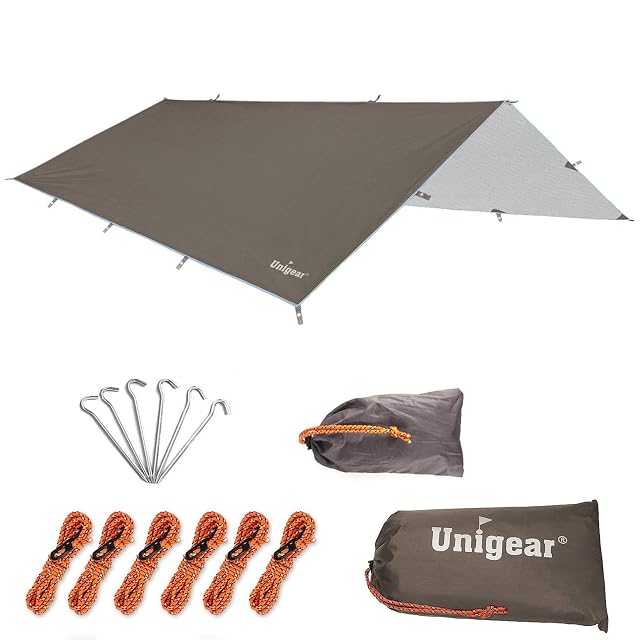
The Unigear is the one to read first, for a reason that has nothing to do with the fabric: it publishes a tie-out count, and it publishes it size by size. Eight loops on the 3 x 3 m, eighteen on the 3 x 4 m, nineteen on the 3 x 5 m, sixteen on the 4.4 x 4.4 m. Attachment points are what let one sheet become a lean-to, an A-frame, a flying diamond or a porch, and a tarp with eight of them and a tarp with nineteen are not the same tool. It also publishes a PU 3000 mm water column, a 210D Oxford weave with a silver coating inside, and a bag containing six adjustable nylon guylines of 4 m, six aluminium pegs and a separate pouch for them, packing to 30 x 17 x 10 cm.
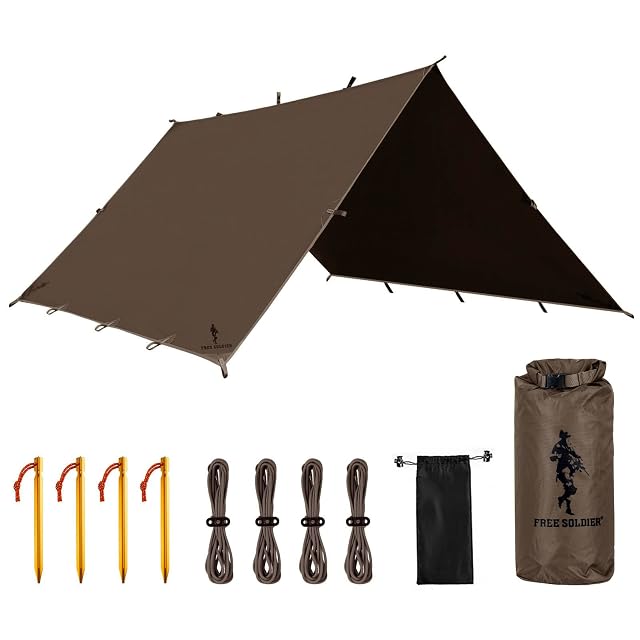
The FREE SOLDIER publishes the other half of the argument: a 300 x 300 cm square in 150T ripstop polyester, seam-sealed, with every load point reinforced with multiply-stitched nylon webbing stated to spread the load across the strap. Reinforcement is where a tarp tears, and a listing that describes the stitching at the load points is describing the failure it has thought about. It states 1 kg, and does not say whether the four ropes and four pegs are inside that figure. Its water resistance is published as a 3000 PU coating, with the figure given without a unit.
Reading a tarp’s cut size
A tarp does not have a floor, so its cut size is doing the work of both a footprint and a roof. Square sheets — the 300 x 300 cm on both tarps here — pitch in the most configurations. Rectangles favour one long axis, which suits a hammock or a two-person lean-to.
Fabric is published unevenly. The Unigear gives a denier — 210D Oxford — while the FREE SOLDIER gives 150T, which is a thread count and not the same measurement at all. Reading one against the other is reading two different quantities.
Which route to take
Take the bivy if the pitch is unknown, the trees are absent, and the priority is packing small and lying down anywhere. Then buy on the breathability figure, and if there is not one, buy knowing there is not one.
Take the tarp if there are trees or poles, if you want to cook and sit under cover, and if you would rather have air moving than fabric on your bag. Then buy on the tie-out count and on what is in the bag, because a canopy without lines and pegs is a half-purchase.
And take both if the trip is long: a tarp overhead and a light cover on the sleeping bag is the combination that handles a night of rain and a night of dew without carrying a tent for either.
Where the water actually gets in
A water column describes a fabric. A seam is where that fabric ends, and it is where water gets in first — so the seam line deserves the same reading as the millimetres. The GEERTOP states fully sealed seams with double stitching, the normani states welded seams, and the FREE SOLDIER states waterproof treatment at the seams. The MFH and the Carinthia publish a fabric and say nothing about what holds it together.