Skip to content

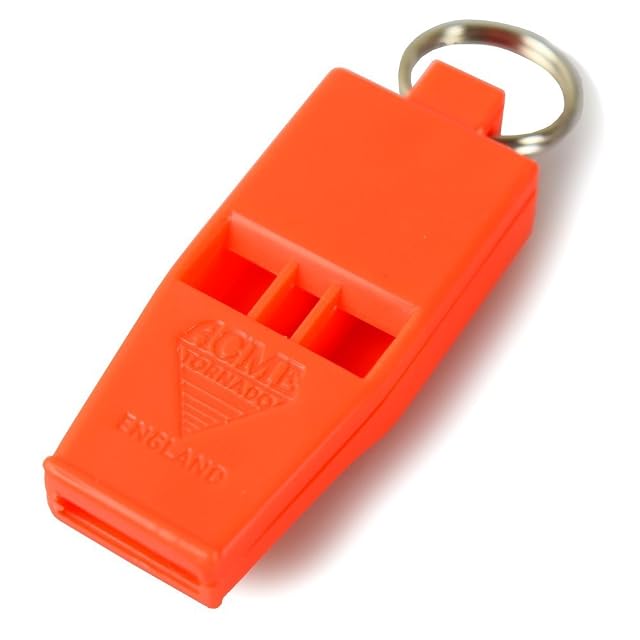
ACME Tornado Slimline No. 636, orange, pealess, three air outlets

The one listing on this shelf that states outright it has no ball inside, and the one that publishes no decibel figure at all — it gives a frequency, up to 4000 Hz, and leaves the loudness claim as words.

ACME Tornado Slimline No. 636 whistle in fluorescent orange on a key ring

ACME Tornado Slimline No. 636, orange, pealess, three air outlets

The one listing on this shelf that states outright it has no ball inside, and the one that publishes no decibel figure at all — it gives a frequency, up to 4000 Hz, and leaves the loudness claim as words.

Pealess or pea design
Pealess — stated; the maker writes that this model has no ball, unlike a conventional trill whistle
Material
Not published on the listing — the body is described as small, thin, light and fluorescent orange, with no polymer or metal named
Dimensions
Not published on the listing
Stated weight
Not published on the listing — described as particularly light, with no gramme figure
Published decibel figure
Not published on the listing — the maker publishes a frequency instead, tones of up to 4000 Hz, and calls the whistle one of the loudest in the world
Distance quoted at
Not published on the listing — the maker states a carry still audible at kilometres, which is a claim about range and not a distance attached to a measurement
Attachment type
Key ring — stated; the maker describes it fitted to trekking rucksacks and buoyancy aids
Amazon reference
B000SE9NMY (same reference on 6 Amazon marketplaces)
EAN
0717668126361
  • One of only two listings in this hub that state in plain words whether there is a ball inside, and it states there is none
  • Publishes a frequency, up to 4000 Hz, which no other listing on this shelf gives at all
  • No decibel figure at all, on the one specification the other six listings lead with

Best for: Someone who wants the pealess question answered on the page rather than inferred, and who is content with a frequency in place of a loudness number.

≈ $8 / £5 / 8 €
Check price on Amazon
Specifications

Pealess or pea design
Pealess — stated; the maker writes that this model has no ball, unlike a conventional trill whistle
Material
Not published on the listing — the body is described as small, thin, light and fluorescent orange, with no polymer or metal named
Dimensions
Not published on the listing
Stated weight
Not published on the listing — described as particularly light, with no gramme figure
Published decibel figure
Not published on the listing — the maker publishes a frequency instead, tones of up to 4000 Hz, and calls the whistle one of the loudest in the world
Distance quoted at
Not published on the listing — the maker states a carry still audible at kilometres, which is a claim about range and not a distance attached to a measurement
Attachment type
Key ring — stated; the maker describes it fitted to trekking rucksacks and buoyancy aids
Amazon reference
B000SE9NMY (same reference on 6 Amazon marketplaces)
EAN
0717668126361

What this listing puts on record

The Tornado Slimline No. 636 in orange: a whistle the maker states has no ball inside, with three air outlets, described as one of the loudest in the world, reaching tones of up to 4000 Hz, small, thin and light enough for a key ring, and waterproof.

A frequency where the others print decibels

Six of the seven listings on this shelf print a decibel figure. This one prints 4000 Hz instead — a frequency, which says how high the tone sits, not how loud it is. It is the only frequency figure in the hub, and it is the only listing here with no decibel number at all.

The maker also writes of a carry still audible at kilometres. That is a claim about range, not a distance attached to a measurement, and it is left here in the manufacturer’s own terms.

Two numbers that answer different questions are not two grades of the same answer. What this listing gives is a pitch; what the other six give is a loudness claim with no distance behind it. Neither set is comparable to the other.

No ball inside, and the maker says so

Pealess — stated. The second bullet says in as many words that this model has no ball, unlike a conventional trill whistle, and that its volume is distributed across three air outlets.

That matters because it is the one design division this family is chosen on, and only two of the seven listings here state which side of it they fall on. A ball is a moving part; a shaped chamber is not. This maker publishes which it built.

Five lines this listing never fills

No material. The body is called small, thin, light and fluorescent orange, and never named as a polymer or a metal — one of only two listings in this hub that skip it.

No dimensions and no weight, on the listing whose whole design argument is slimness.

No decibel figure and no distance. For an object sold on being heard, the loudness claim arrives as a phrase and as a hertz reading, and never as a number with a measuring point behind it.

The maker lists where the whistle turns up: on trekking rucksacks and buoyancy aids, in refereeing, as a training whistle across several sports and as a dog whistle, and it notes that this model was once standard issue on life vests. Those are the manufacturer’s descriptions of where the object ends up. What a whistle is for, and how it is meant to be used, are questions for the manufacturer’s own instructions rather than for this page.

Availability

Selling at about 8 € on the German, French, Italian and Spanish Amazon stores when this page was checked.

It also sells on the American and British Amazon stores in the local currency, which the range above does not cover — that range counts euro stores and nothing else.

Every figure in this section is what Keepa returned on the day this page was last updated. Prices and offers change without notice.

Prices quoted in this text were read on 6 September 2026. The live price is at the top of the page.

All signal whistles