Poles are the cheapest piece of kit on this site that changes how a long descent feels, and they are bought on four figures. Three of those are usually published. The fourth is usually not.
Weight, and whether it is one pole or two
This family is better than most on this site at labelling its weights, and that is worth saying plainly: most of these listings state a figure per pole and say so explicitly.
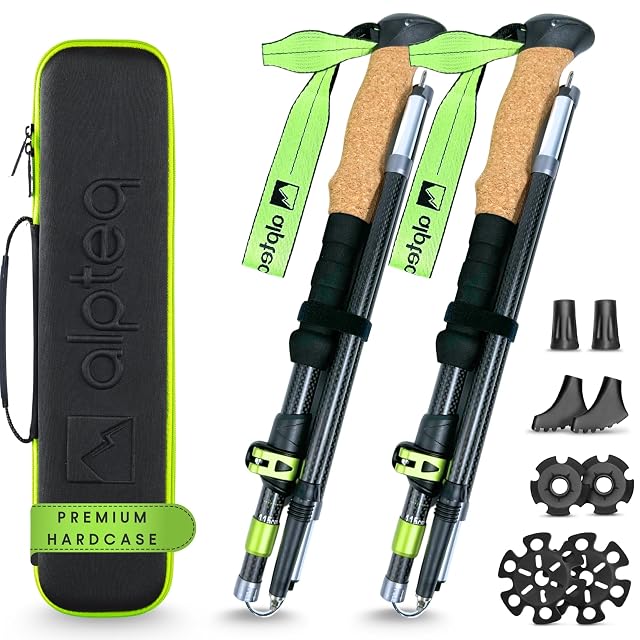
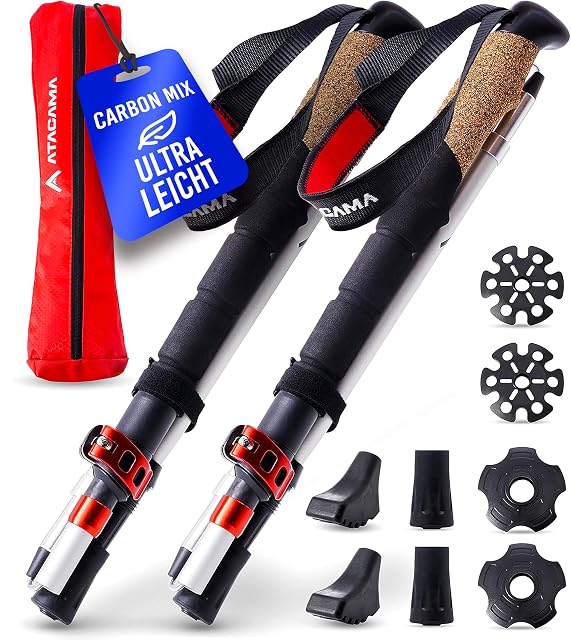
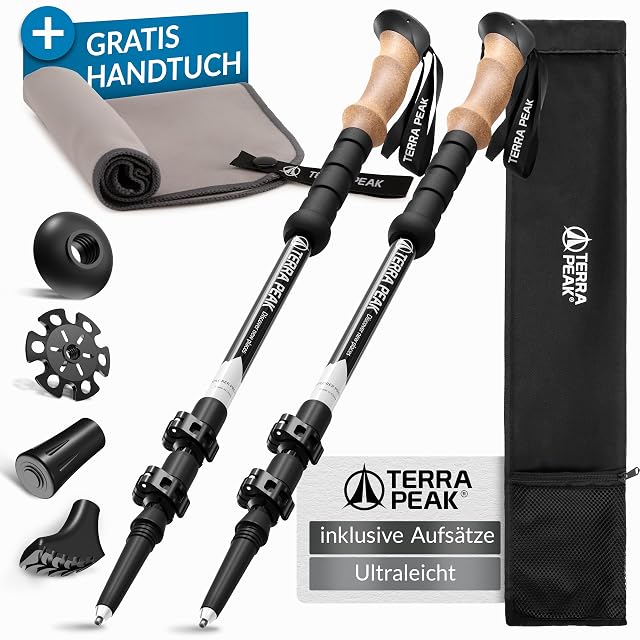
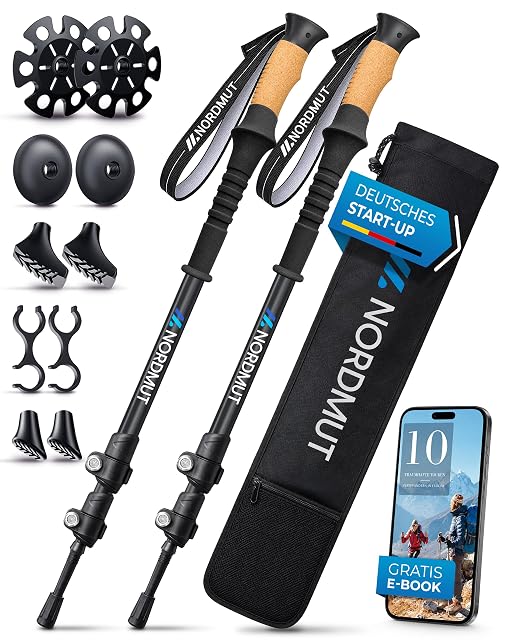
The KEYTYTAR states 169 g per pole, in its title and again in its bullets. The Alpteq states 231 g per pole. The Atacama and the Terra Peak both state 270 g per pole. The NORDMUT states 325 g per pole. The PINUQUEST elsewhere on this site states 260 g per pole for its aluminium version and 210 g for the carbon one, and names which version the reference is.
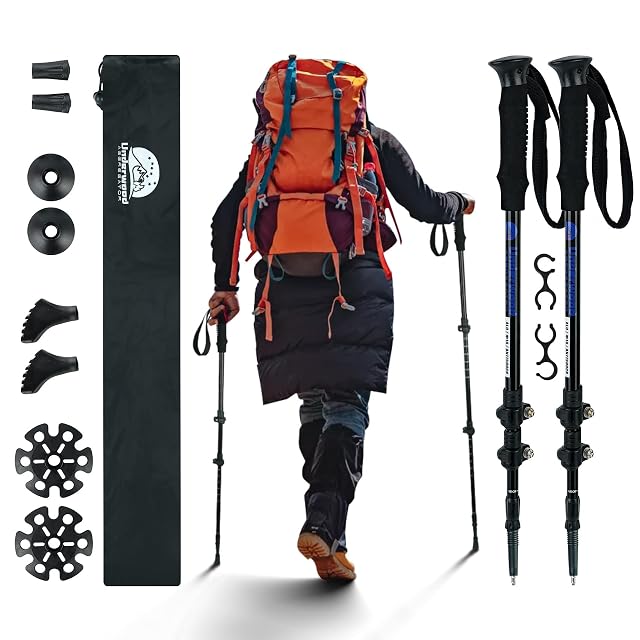
Against that background the Underwood Aggregator stands out: 560 g, unlabelled. That figure is roughly two of the mid-weight poles above, and it is also plausible as a single heavy telescopic pole. The listing does not say, and there is no way to tell from the page.
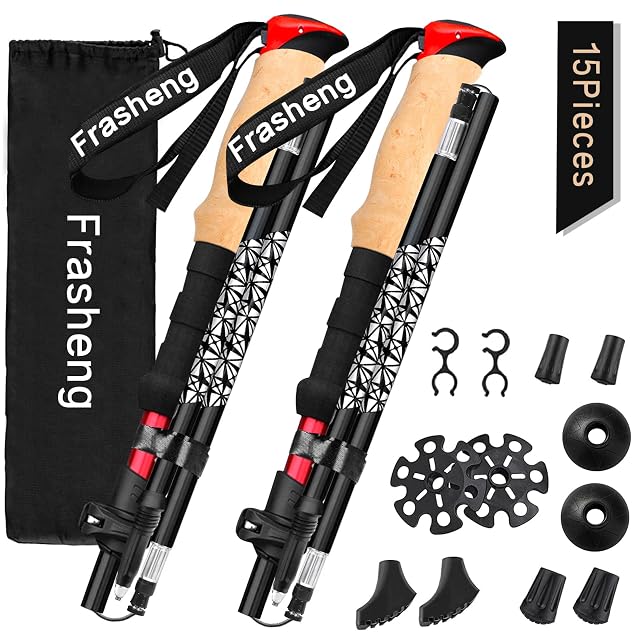
The Frasheng publishes no weight per pole at all.
Between the KEYTYTAR at 169 g and the NORDMUT at 325 g there is nearly double the mass, carried in your hands for the whole day. That is the single biggest spread in this family.
Packed length, and where it goes missing
If poles travel inside a case or a pack, packed length decides the purchase before anything else.
The Alpteq states 35 cm folded. The Atacama states 36 cm, the DOBESTS 36 cm in its supplied bag, the Frasheng 36 cm. The Underwood Aggregator states 45 cm in its bag — the length of a telescopic pole that collapses into itself rather than folding at joints.
The KEYTYTAR does not publish one, and neither does the Terra Peak or the NORDMUT. On the KEYTYTAR that is the notable gap, because a folding carbon pole at 169 g is exactly the pole somebody buys to put in a case.
Length range, and the listings that contradict themselves
Maximum length is published everywhere. Two listings publish it more than once and do not agree with themselves.
The Frasheng gives its adjustment range as 108 to 135 cm in its title and 115 to 135 cm in its bullets. Its shaft material is published twice too: 7075 aluminium alloy in the bullets, carbon and aluminium in the title. Neither pair is reconciled on the page, and both are the sort of thing to settle with the seller before ordering rather than after.
The rest are consistent. The Alpteq adjusts 115 to 135 cm. The Atacama 110 to 135. The Terra Peak 110 to 135. The NORDMUT 65 to 135. The Underwood Aggregator 60 to 135. The KEYTYTAR is the outlier at 63 to 125 cm — a lower ceiling than everything else here, and the figure to check against your own height before the 169 g becomes tempting.
A wide range matters in a household where more than one person uses the poles, and it matters if you shorten them for a climb and lengthen them for the descent.
The lock, and why its absence is a real omission
The lock is the moving part. It is what slips when a pole is loaded on a steep step, and it is what you retighten with cold hands.
Atacama states an external flip-lock lever for stepless height adjustment. Terra Peak names its lever system — an aluminium external lever the maker calls Fastlock. Frasheng states an external flip-lock lever, which its title calls a clamp closure. The Underwood Aggregator states both an external flip-lock lever and a twist collar on the lower section, and publishes instructions for tightening each — which is more than any other listing here does.
The Alpteq, the KEYTYTAR and the NORDMUT name no lock mechanism at all. That is a real gap, because an internal twist lock and an external lever are serviced completely differently, and one of them can be adjusted in gloves.
Not one listing in this family publishes a section count.
Grips: cork or foam, and what each is for
Cork absorbs sweat and holds its shape to the hand over time. Foam is lighter and warmer in the cold, and it wears faster.
Alpteq states natural cork with a non-slip EVA extension below it. Atacama states cork in a dual-grip arrangement following the shape of the hand. Terra Peak states real cork with an extended EVA hand grip. NORDMUT states natural cork with an EVA foam extension, stated to absorb sweat and insulate against cold. Frasheng states cork described as non-slip with sweaty hands.
KEYTYTAR and the Underwood Aggregator both state EVA foam. On the KEYTYTAR that is part of how the 169 g is reached.
The extension below the grip is the detail worth looking for: it lets you drop your hand down a traverse without stopping to change the length.
Tips and baskets, which are the parts you replace
Attachments are supplied generously across this family and described loosely.
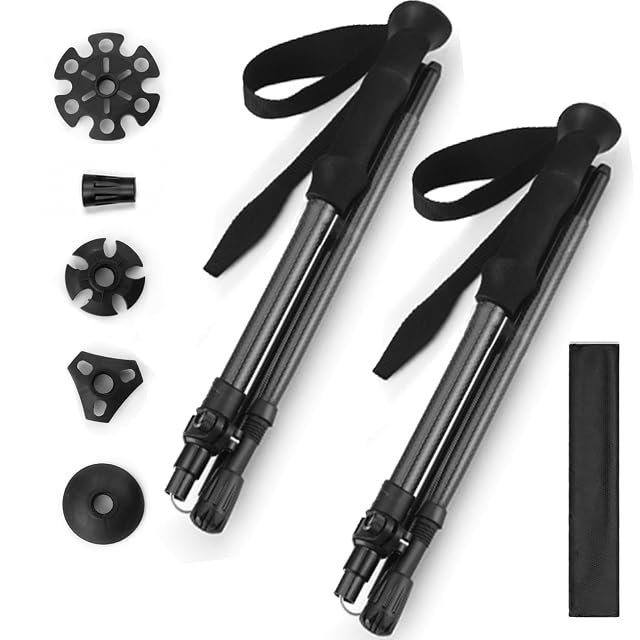
The Underwood Aggregator supplies four sets — rubber tips, mud tips, boot tips and snow tips. The PINUQUEST supplies four pairs for asphalt, terrain, mud and snow. NORDMUT supplies three pairs of rubber buffers and two anti-sink baskets. Atacama supplies a rubber buffer set with a water-repellent bag. KEYTYTAR supplies snow and mud baskets.
Here is the recurring gap: almost none of these listings names a thread or fitting standard, so a replacement basket ordered on a photograph may not fit. The Frasheng is the exception and it is worth noting — it states two small screw-on trekking baskets and two screw-on snow baskets, and it is the only listing here that says how they fix.
Where each pair lands
Alpteq for a pole that goes in a case: 35 cm folded, 231 g per pole, cork over carbon. KEYTYTAR if the gram count rules and 125 cm is enough length. Atacama for a folding pole with a named lock and a published packed length. Terra Peak for a named external lever and cork grips on a telescopic shaft. NORDMUT for a warm cork grip on a long day, at 325 g a pole. Frasheng for screw-on baskets, once the contradictions in its own listing are settled. Underwood Aggregator for a household of mixed heights, if you are content with an unlabelled 560 g.