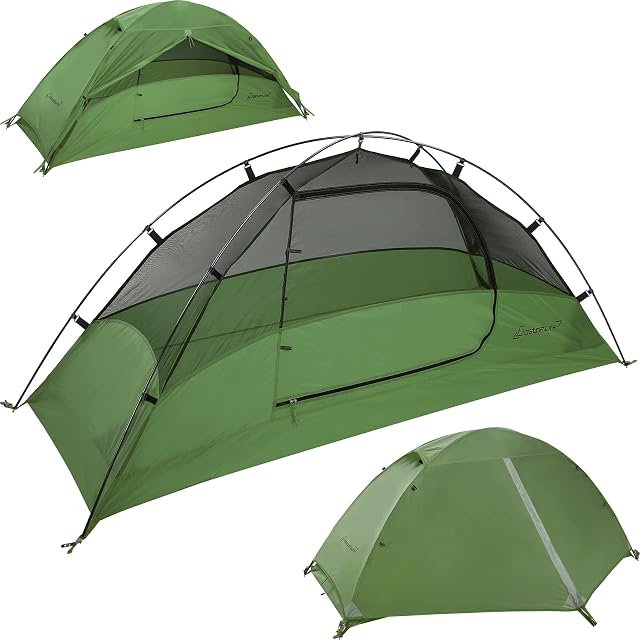
The bottom line A light, low, honest listing: it gives the fly figure, names the pole material, and states its own pitching limitation. What it does not give is the floor number, and on a PE groundsheet that is the figure worth asking for.
What this listing puts on record
A weight of 1.5 kg, a rolled pack size of 12 × 38 cm, a 3000 mm water column with taped seams, a waterproof PE floor, a flat wind-shedding profile, fibreglass poles, Dyneema guylines with Clamcleat tensioners, reflective guylines and pegs in the box, and an inner tent that stands independently of the fly.
The bullet worth reading twice
It only stands guyed out. The last bullet ends with a warning in the maker’s own words: the tent stands only when tensioned, and standing without pegs is not possible. That is not a fault — it is a design choice that saves weight — but it decides where the tent can be used.
The published figure and the missing one
3000 mm on the fly, with taped seams. That is the panel the rain lands on, and it is stated.
PE on the floor, with no figure. Polyethylene is the sheet-material floor used at the light and cheap end; it is genuinely waterproof but it is not given a millimetre figure here, and a PE floor on a stony pitch is the part most likely to need a groundsheet under it.
What the separate inner buys you
The inner stands alone. On a warm dry night that is a bug shelter with a view, and it is the reason to prefer a two-part tent over a single-skin one at this weight.
Before ordering
Check the pitches on your route for peg-friendly ground, and consider a footprint for the PE floor if you camp on gravel or forest litter.
Availability
Selling at about 70 € on the German Amazon store when this page was checked.
Catalogued on the American, British, French, Italian and Spanish Amazon stores with nobody selling it: the reference is there, the offer is not.
Every figure in this section is what Keepa returned on the day this page was last updated. Prices and offers change without notice.
Prices quoted in this text were read on 6 September 2026. The live price is at the top of the page.
What it does well, and where it gives way
Strengths
Publishes 3000 mm for the flysheet and names taped seams alongside it
States plainly that the tent will not stand without pegs, which is the kind of limitation most listings leave you to discover
The inner tent is stated to stand on its own and to be usable without the fly on warm nights
Compromises
The floor is described as waterproof PE and given no water column figure, so the wet-ground half is unpublished
Fibreglass poles are the heavier and more brittle choice, and there is no spare section or repair sleeve named in the listing
No floor dimensions and no peak height, so a 1.5 kg tent cannot be checked for whether a sleeping mat and a pack both fit
Specifications
Trail weight
Not published on the listing — a single unlabelled figure is published
Packed weight
1.5 kg — stated as the tent's weight; the maker does not say whether pegs and guylines are counted
Floor area
Not published on the listing
Peak height
Not published on the listing — the build is described as flat to reduce the face it offers the wind
Hydrostatic head — flysheet
3000 mm — stated, alongside taped seams
Hydrostatic head — groundsheet
Not published on the listing — the floor is described as waterproof PE, with no water column figure
Fabric denier
Not published on the listing
Pole material
Fibreglass — stated, with Dyneema guylines and Clamcleat tensioners
Pitch type
Not freestanding — the listing states in as many words that the tent only stands guyed out and cannot stand without pegs
Season rating
Not published on the listing
Amazon reference
B0F1Z523KJ (same reference on 6 Amazon marketplaces)
EAN
4011739546321
What people ask before buying
What does "only stands guyed out" rule out?
Wooden platforms, gravel bays, rock slabs and anywhere else a peg will not bite. A freestanding tent can be weighted down instead; this one cannot, and the listing says so rather than leaving it to the first night out.
Are fibreglass poles a problem?
They are heavier for the same strength and they splinter rather than bend when they fail, which is why a repair sleeve matters more with them. They are also cheaper, and on a tent used a few nights a year the difference may never show.
Two person · freestanding · 7001 aluminium pole · 20D silicone nylon · 4000 mm + fabric figure · 1.9 kg unlabelled
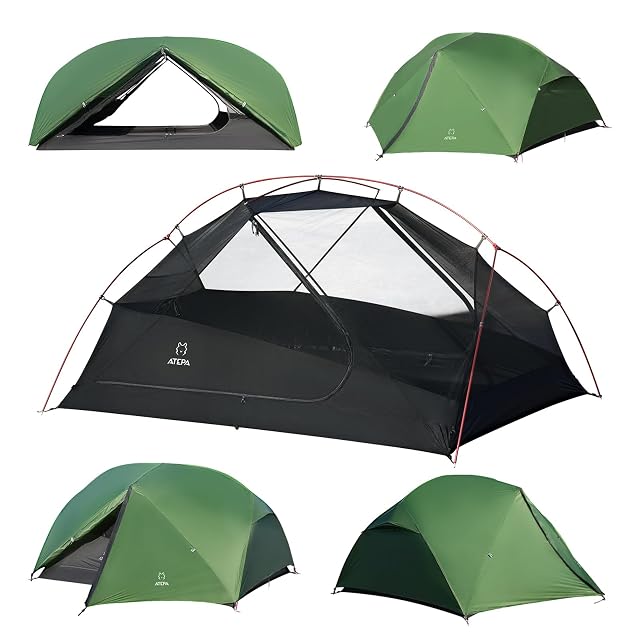
A freestanding 20D nylon tent that names its pole alloy and gives a 4000 mm figure to the fabric rather than to a panel, so the floor is left without one.
Best for: Two people who camp where pegs may not bite and want a named pole alloy under a 20D fly.
Two person · two doors and two vestibules · 68D polyester · 2.5 kg unlabelled · no water column published
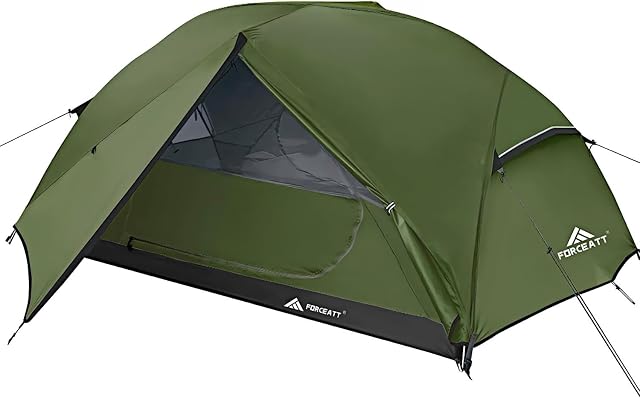
A two-door two-person tent that publishes its fabric denier — rare on this shelf — and no water column at all, and whose floor dimension is cut off mid-sentence.
Best for: Two people who want a door each and a thicker 68D fabric, on pitches where rain is a shower rather than a night of it.