On the maker’s own page
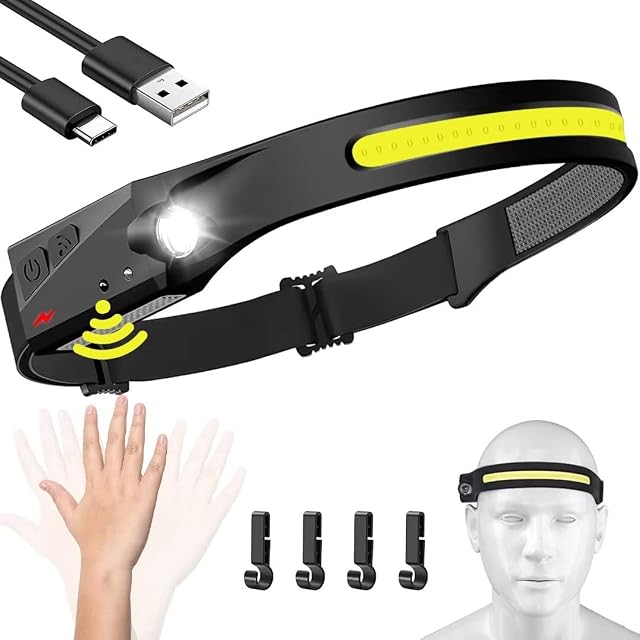
A rechargeable two-pack with a motion sensor, 1.87 oz a lamp.
LHKNL states a long-press function holding the mode button for three seconds to
switch off from any mode, and a motion sensor mode switching the light on or off
with a wave of the hand; class-leading LED chips providing 2X brighter high
lumens, a rated 1500 mAh built-in rechargeable battery that can charge and light
at the same time, a battery indicator, and 4 to 10 hours from a full charge; a
weight of 1.87 oz with a head that rotates 60 degrees and fixes tightly; IPX4
waterproofing and eight lighting modes including main strong, main weak, side
strong, side weak, red beam and SOS red strobe; and packaging in sets of two.
No lumens. No beam distance. No mode attached to the runtime. No lock mode.
Fifty-three grams, the lightest on this shelf
One point eight seven ounces, stated.
Seventeen lamps sit on this shelf. The lightest figure on the European side is
about 68 g (2.4 oz), and the American lamps run from this to about 3 oz.
The weight is carried with the 1500 mAh pack on the head rather than in a
separate battery box behind it.
Four to ten hours, and no setting named
A span, not a column.
This shelf’s buying tip asks for the setting you will actually walk on. Eight modes
are listed and the runtime is attached to none of them.
This shelf’s introduction explains why that matters twice over: a runtime is defined
under ANSI/PLATO FL1 as the point at which output has fallen to a tenth of its
initial value, and no lamp on this shelf quotes that convention or says whether
its output is regulated.
So the 10 hours may be ten hours of light, or ten hours of fading.
2X brighter than what
The listing does not say.
No lumen figure appears anywhere on the page. The claim is a multiplier against
an unnamed comparison.
This shelf’s introduction calls peak lumens the least useful figure in the category,
which is true — but it is still the figure every other lamp here publishes, and
two of the eight American listings on this shelf publish none.
Availability
The American Amazon store was listing it at about $20 at the time of writing.
Every figure here is what Keepa held on the day this page was last revised. Offers and prices shift without warning.
Prices quoted in this text were read on October 8, 2026. The live price is at the top of the page.
What people ask before buying
How long does it last on the setting I will walk on?
The page does not say. What it publishes is 4 to 10 hours from a full charge, with no mode attached to either figure — so the 10 hours might be the side light at its weakest and the 4 hours the main beam at full, but the listing leaves that to you. This shelf's buying tip asks you to compare lamps on the setting you will actually walk on, and only one lamp on this whole shelf publishes a runtime for a named middle setting: the EverBrite five-pack in this group, at 150 lumens for 10 hours. This shelf's introduction also explains why a bare span is weaker than it looks, because a runtime means nothing without knowing whether output is held or allowed to decay.
Is a motion sensor useful or a gimmick?
On a lamp used for repairs, cooking or anything with wet or greasy hands, it is useful: a wave within range switches the light without touching the housing, and the listing gives that as the reason — avoiding soiling the headlamp when your hands are dirty. Three of the eight American lamps on this shelf have one. The cost is the obvious one, and the listing does not address it: a sensor that responds to a passing hand responds to a sleeve in a rucksack too, and no lock mode is published here to prevent it.
Fifty-three grams — what is the catch?
There is no stated catch, which is itself the point: the lamp publishes its weight and almost nothing else measurable. One point eight seven ounces is the lightest figure on this shelf, lighter than the 68 g (2.4 oz) European lamp that was the previous lowest, and it is achieved with a 1500 mAh pack on the head rather than a separate battery box. What is missing is every number that would let you set that weight against performance — no lumens, no beam distance, no runtime tied to a mode, no regulation. You are buying a weight and a feature list.