On the maker’s own page
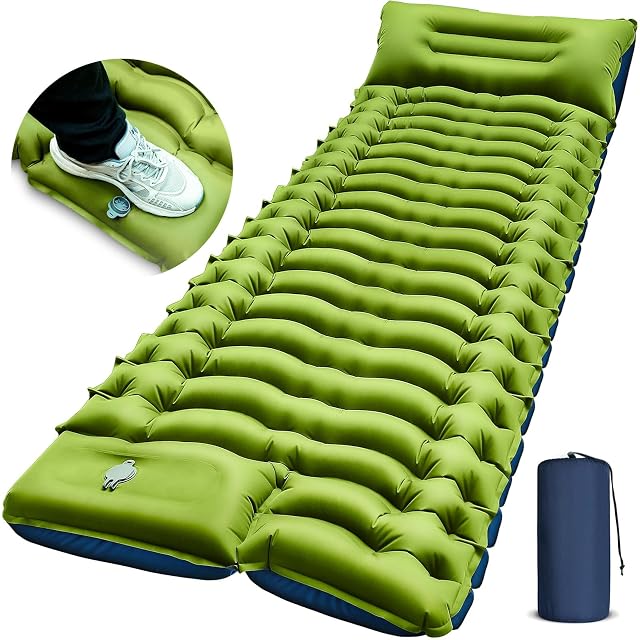
An Oxylus 4.3 R-value insulated air-foam self-inflating sleeping pad, four
seasons.
Gear Doctors states a mat compressing to 8”(20 cm (7.9 in)) × 12”(30 cm (11.8 in)) at 35.2 oz
(997 g (35.2 oz)), expanding to 72”(183 cm (72 in)) × 20”(52) at a thickness of 1.5”(3.8 cm (1.5 in)); setup
from pack to sleep-ready in under five minutes — unroll, open the valve, let it
self-inflate, adjust with a few breaths, close the valve — and repacking by
opening the valve and rolling, held with an included elastic band; a hybrid
4.3 R-value core with a 75D micro-coated polyester shell resisting UV, moisture
and abrasion, leak-proof, with a hypoallergenic outer layer and a lifetime
replacement guarantee; and use on grass, rock, snow or sand.
No standard named.
Four point three, from an inch and a half
Foam inside the air.
An air mat loses heat because the air inside it circulates. Open-cell foam breaks
that air into pockets that cannot move, and it draws air in when the valve opens.
So a thinner mat with foam can out-insulate a fatter hollow one. The other 4.3 in
this group is 2.6 inches thick; this one is 1.5.
This shelf’s introduction separates the two questions exactly here: R-value carries
the warmth, thickness decides whether your hip lands.
And no standard
The figure this shelf’s introduction asks to see attached.
Since ASTM F3340, R-values across makers can be compared — if the figure is
quoted against it.
Not one of the eight mats in this group names it. Two publish 4.3, and the two are
built differently enough that the question is a real one.
Seventy-five denier, working harder
The fabric as a pressure vessel.
On a hollow air mat the fabric holds air. On a self-inflating mat it also
restrains foam that wants to expand, so the same denier is doing more.
Seventy-five is the joint-thickest fabric on this shelf, against 40D on one air
mat and 20D on the lightest. UV, moisture and abrasion resistance and a
hypoallergenic layer are all named with it.
Twenty inches, and fifty-two centimeters
A conversion that does not convert.
“72”(183cm (72 in))×20”(52)”. The length is right; 20 inches is 50.8 centimeters.
One point two centimeters changes nothing in use. It is worth a line only because
this shelf is compared on published figures, and a conversion that is out is a
specification typed rather than measured.
Twenty inches is also the second narrowest width here.
Gear Doctors’ instructions carry the inflation and the repack. Nothing here
replaces them, and nothing on this page describes any product as safe.
Availability
The American Amazon store was listing it at about $51 at the time of writing.
Every figure here is what Keepa held on the day this page was last revised. Offers and prices shift without warning.
Prices quoted in this text were read on October 8, 2026. The live price is at the top of the page.