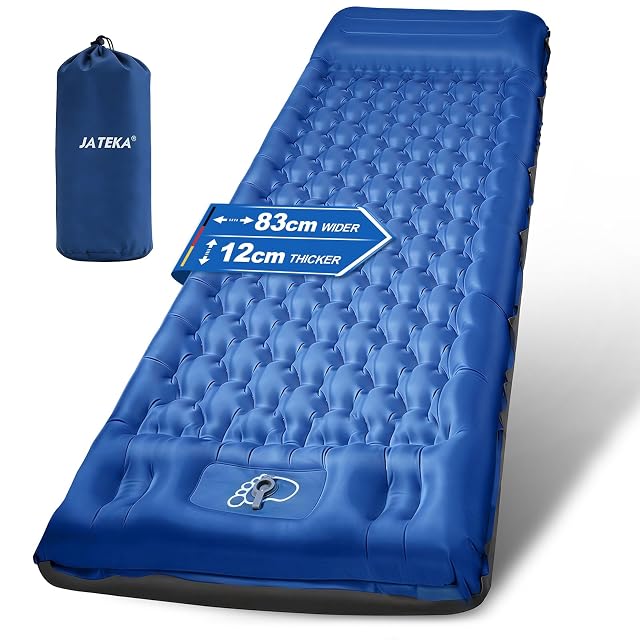
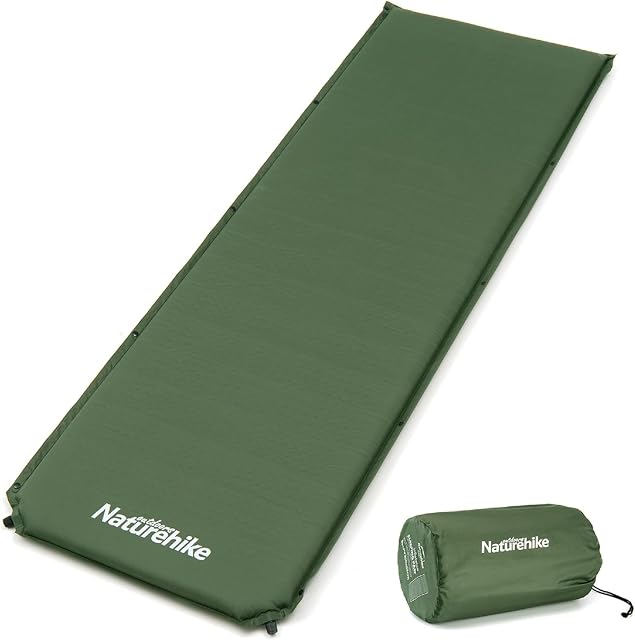
The bottom line A light mat whose dimensions are described more carefully than almost anything else here, and whose thickness and warmth are not described at all. Buy it on the 531 g and the 190 cm; do not assume it insulates.
What this listing puts on record
A weight of 531 g, a 40D material, an ergonomically shaped outline said to support a natural sleeping posture, inflation by breath, and dimensions given twice: 225 × 70 cm uninflated and 190 × 60 cm inflated. A repair kit is in the box.
Two sets of dimensions, and why that is the right way to do it
225 × 70 cm flat. 190 × 60 cm inflated. As the chambers round out they pull the fabric in — 35 cm of length and 10 cm of width, on this mat.
Most listings publish only the flat figure, and a buyer measuring their tent gets a pleasant surprise and a buyer measuring themselves gets an unpleasant one. Publishing both is a small piece of honesty and it is worth noting.
The number that decides comfort, missing
Thickness. Nowhere in the listing. A 531 g mat is thin by definition, but how thin decides whether a side sleeper’s hip finds the ground through it, and that is not a question the page answers.
The number that decides warmth, also missing
R-value, with no standard named. ASTM F3340 exists precisely so that figures from different makers can be compared, and there is nothing here to compare.
What the repair kit says
It is in the box, stated plainly. An air mat is one thorn from useless, and a maker who supplies patches with the mat has thought about the second night as well as the first.
Before ordering
Check 190 cm against your own height, and plan the warmth around the sleeping bag rather than around the mat.
Availability
Selling between 40 € and 45 € across the German and French Amazon stores when this page was checked.
Catalogued on the British, Italian and Spanish Amazon stores with nobody selling it: the reference is there, the offer is not.
Nothing came back from the American Amazon store, so the buy link there opens a local search instead of a page that is not there.
Every figure in this section is what Keepa returned on the day this page was last updated. Prices and offers change without notice.
Prices quoted in this text were read on 6 September 2026. The live price is at the top of the page.
What it does well, and where it gives way
Strengths
Publishes the flat and the inflated dimensions separately, which is the honest way to describe a mat that shortens as it fills
A low published weight of 531 g with a 40D material behind it
A repair kit is stated as included, which on an air mat is the accessory that matters
Compromises
No thickness at all, so how far a hip sinks towards the ground is unpublished
No R-value and no standard, and an ergonomically shaped mat gives no clue to its insulation
No packed size in centimetres, only a claim that it stows easily
Specifications
R-value
Not published on the listing — no insulation figure appears in the listing
Standard quoted
None named — no ASTM F3340 reference appears in the listing
Thickness
Not published on the listing
Packed size
Not published on the listing — described only as taking up very little room in a pack or a case
Weight
531 g — stated, with no label saying what is counted
Width
60 cm inflated, from a 70 cm flat width — both stated
Length
190 cm inflated, from a 225 cm flat length — both stated
Fabric denier
40D — stated as the material; the fibre itself is not named
Inflation method
By mouth — stated as a few puffs; a repair kit is included
Amazon reference
B0BXFMHYDF (same reference on 5 Amazon marketplaces)
EAN
4260760680751
What people ask before buying
Why are the flat and inflated dimensions different?
Because filling a mat pulls the fabric in as the chambers round out. A mat cut at 225 × 70 cm flat sleeps at 190 × 60 cm. Most listings publish only the larger number; publishing both, as this one does, is the more useful and the more honest.
Is 190 cm long enough?
For most people up to about 180 cm tall, yes, with the head on a stuffed jacket or a pillow. Above that your feet will be over the end and on the ground, which is where the missing R-value stops being an abstract question.