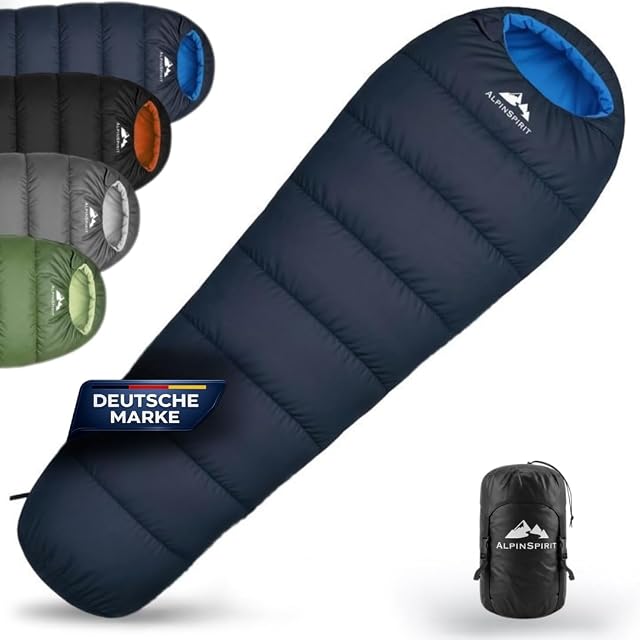
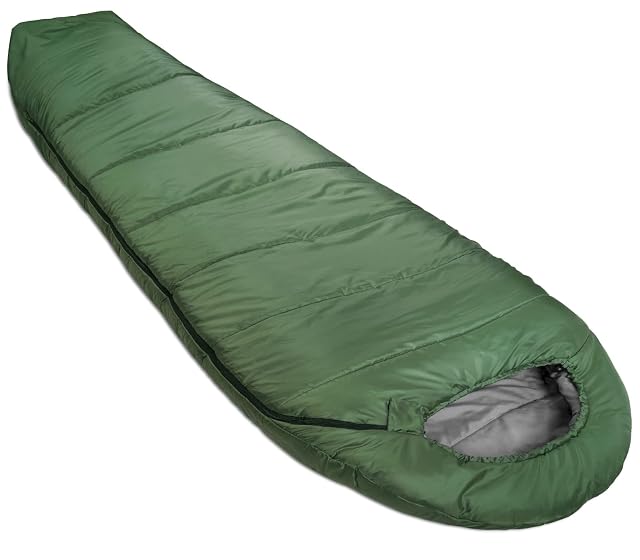
A 400 GSM fill, comfort to +4 °C (39 °F), limit to -2 °C (28 °F) and an extreme figure of -17 °C (1 °F), a classic mummy cut, left and right versions that couple into a double, a padded head area with a drawcord, a two-way zip with a baffle and an anti-snag strip, all-polyester construction with a water-repellent outer, machine washing at 30 °C (86 °F), a compression sack, and a total weight of 1.55 kg (3.4 lb).
Three figures, and what to do with each
+4 °C comfort and -2 °C limit. Two points rather than a range, which is how a tested bag is described — but no standard is named here, so they remain the maker’s own figures.
-17 °C extreme. This third number belongs to a different question entirely. In the standards it marks survival rather than sleep; it is not a temperature to plan a night around, and it is not a figure this page ranks on.
What 400 GSM is and is not
It is the density of the wadding, in grams per square meter. It is not the weight of insulation in the bag. Two bags at 400 GSM in different sizes carry different amounts of fill, and only one of them may suit you.
The detail that is genuinely useful
The zip. A two-way zip that opens from the foot, a baffle behind it so the cold does not come through the teeth, and an anti-snag strip so the lining is not chewed. Those three details are named, and they are what separates a bag you can use from one you fight.
Before ordering
Choose the zip side. Left and right versions exist so two bags couple into a double, and getting two of the same hand means they will not.
Availability
The American Amazon store returned nothing, so the buy link opens a local search rather than a page that is not there.
Every figure here is what Keepa held on the day this page was last revised. Offers and prices shift without warning.
What it does well, and where it gives way
Strengths
Publishes comfort and limit as two separate figures, +4 °C (39 °F) and -2 °C (28 °F), which almost nothing else on this shelf does
States a total weight of 1.55 kg (3.4 lb) and supplies a compression sack with it
Names the hardware in detail: a two-way zip in left or right versions, a zip baffle against accidental opening, and an anti-snag strip against the lining
Compromises
No standard is named, so the +4 °C (39 °F) cannot be compared with a figure measured under EN 13537 or ISO 23537
No packed size is published, which makes the compression sack a claim rather than a measurement
400 GSM is a fill density, not the grams of insulation in the bag, so the fill weight is still unknown
Where this model is listed
A listing is not an offer: the reference exists on these stores, availability changes daily.
France
Germany
Italy
Spain
United Kingdom
Specifications
Comfort rating
+4 °C (39 °F) — stated; no standard is named, so it is an unstandardized figure
Limit rating
-2 °C (28 °F) — stated; no standard is named, so it is an unstandardized figure
Standard quoted
None named — neither EN 13537 nor ISO 23537 appears, and a third figure of -17 °C (1 °F) is published as an extreme value, which is not a temperature to plan a night around
Fill power
Not published on the listing — fill power describes down, and this bag is stated as all polyester
Fill weight
No weight published — the maker publishes 400 GSM, a fill density in grams per square meter, not the grams of insulation in the bag
Down or synthetic
Synthetic — stated as entirely polyester, with a soft inner lining
Shell denier
Not published on the listing — a hard-wearing water-repellent outer is described, with no yarn weight
Baffle construction
Not published on the listing — a padded head area, a zip baffle and an anti-snag strip are named; the body construction is not
Packed size
Not published on the listing — a compression sack is supplied and the pack size is described only as small
Weight
1.55 kg (3.4 lb) — stated as the total weight
Amazon reference
B0FGJDF3NT
EAN
4251379387889
What people ask before buying
What is the difference between comfort and limit?
Under EN 13537 and ISO 23537 they are two points from the same mannequin test: comfort is where a standard sleeper rests without curling up, limit is where they can still sleep curled. This listing uses both words and names no standard, so treat the pair as the maker’s own indication.
What does 400 GSM actually describe?
Grams per square meter of the insulation layer. It says how dense the wadding is, not how much of it is in the bag — a longer or wider bag at the same GSM contains more insulation and weighs more. It is a useful comparison between bags of similar size and nothing more.
Does ALPIDEX publish a standard quoted?
No. None named — neither EN 13537 nor ISO 23537 appears, and a third figure of -17 °C (1 °F) is published as an extreme value, which is not a temperature to plan a night around. What the listing does publish instead is the comfort rating: +4 °C (39 °F) — stated; no standard is named, so it is an unstandardized figure.
Our score
7.8/ 10
The most carefully specified temperature claim in this group, with the same missing standard as all the others. For a mummy bag at 1.55 kg (3.4 lb) with real hardware detail it earns its place; read the +4 °C (39 °F) as the maker’s figure rather than a tested one.
The buyer this one serves, among camping gear
Three-season camping where a stated comfort and limit pair matters more than a published packed size.
Specifications: the manufacturer sheet for camping and hiking gear and the matching Amazon product page. Prices and availability: Keepa. Every figure on this page names its source.
Mummy · 300 GSM cotton and hollow-fiber fill · comfort 15 °C (59 °F) to 20 °C (68 °F) · about 1300 g (45.9 oz) · 35 × 25 cm (13.8 × 9.8 in) packed
A three-season mummy bag that publishes weight, packed size and fill density, and puts its comfort range at 15 °C (59 °F) to 20 °C (68 °F) with no standard behind it.
Best for: Spring to autumn trips where about 1300 g (45.9 oz) into a 35 × 25 cm (13.8 × 9.8 in) roll is the constraint that matters.
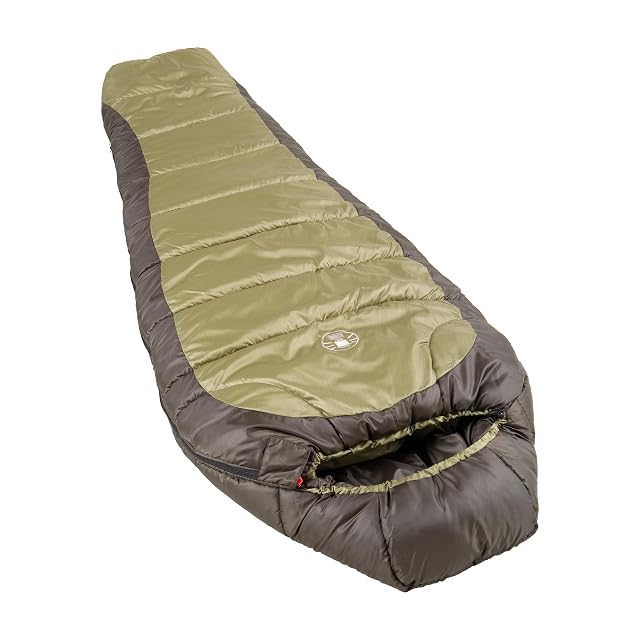
20 °F, no standard · 82 × 33 in · polyester shell, brushed tricot liner · no-snag zip
Five bullets, five facts and no padding: a 20 °F mummy bag of 82 by 33 inches with a drawstring hood, a brushed tricot liner and an anti-snag zip with contrasting webbing.
Best for: A straightforward cold-weather mummy bag with nothing to decode
0 °F, no standard · 82 × 32 in, to 6 ft 2 in · Coletherm fill · quilting against cold spots
The coldest figure in this group at 0 °F, and the only bag here that publishes a quilting construction against cold spots, a named insulation, a draft tube and a box foot together.
Best for: A genuinely cold night in a tent, for a camper up to six foot two