On the maker’s own page
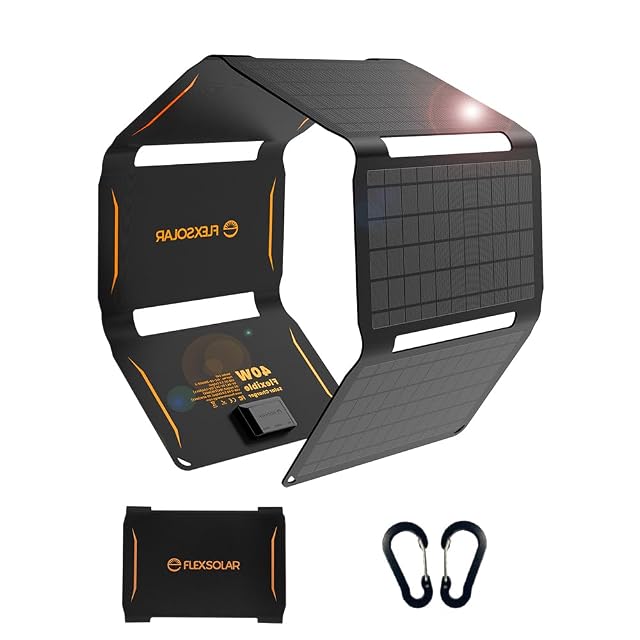
A 10 W 5 V USB foldable solar panel charger, IP67 waterproof.
FlexSolar states a built-in USB-A port at 5 V/2 A maximum for smartphones,
tablets, compact power banks under 10,000 mAh, USB fans, flashlights,
smartwatches and portable routers, with no energy storage capability; a smart IC
chip identifying connected devices with LED indicators and overcurrent,
overheating and short-circuit protection; ETFE film lamination over
high-efficiency monocrystalline A+ cells at a 24 per cent conversion rate, IP67
rated, with the junction box stated not waterproof; a three-fold design of
7.6 × 8.8 × 0.7 inches folded and 15.5 × 8.8 unfolded at 0.66 lbs (300 g (10.6 oz)), with
dual carabiners; and advice to avoid charging through glass, with a maximum 10 W
output under direct sunlight.
No test conditions. No kickstand.
Three hundred grams
The lightest panel in this group, by a long way.
The others weigh 671 g (23.7 oz), 771 g (27.2 oz) and 800 g (28.2 oz). This is 300.
Ten watts from a sheet 15.5 by 8.8 inches is only possible at a conversion figure
like the 24 per cent published here — which is what this shelf’s introduction means
when it says cell type and efficiency tell you how much panel you carry for each
watt.
And no test conditions
The axis this shelf asks for, empty on all four.
This shelf’s introduction is explicit: makers publish the peak watt figure under
standard test conditions — a defined irradiance, a defined cell temperature and a
defined air mass — which the panel meets on a bench, not on a pitch at half past
four in October.
Not one of the four panels in this group publishes any of the three. The figure can
rank these panels against each other and it cannot promise what reaches a
battery.
Twenty-four per cent, and what that number is not
Three listings, one figure, two meanings.
This panel and its stablemate publish 24 per cent as a conversion rate. A rival
publishes 25.4 per cent. The fourth publishes “up to a 24% increase in efficiency
compared to traditional solar cells” — which is an increase, not an efficiency,
and reads like the same number.
The junction box
Not covered by the IP67.
This shelf’s introduction predicts it: an ingress rating usually covers the panel
face while the junction pocket is rated separately or not at all.
All three panels in this group that publish a code say the same of their own
junction box. The face can be rained on; the socket should be shut, shaded or
brought in.
No storage, and no controller
What a bare panel is.
“No energy storage capability”, in the first bullet. A device has to be connected
while the sun is on it.
This shelf’s introduction puts the question plainly: ask whether a charge controller
is built in or lives in the power station, because a bare panel wired to a
battery is not a charging system. None of the four panels here includes one.
FlexSolar’s instructions carry the ports and the ingress rating. Nothing here
replaces them, and nothing on this page describes any product as safe.
Availability
The American Amazon store was listing it at about $25 at the time of writing.
Every figure here is what Keepa held on the day this page was last revised. Offers and prices shift without warning.
Prices quoted in this text were read on October 8, 2026. The live price is at the top of the page.