Opposite ends of the same scale
One of these pages is among the more numerate on its shelf and the other is among the emptiest. Read together they show how much of a specification is a drafting choice rather than a property of the product, since the same badge produced both.
Poles: the material choice can be costed
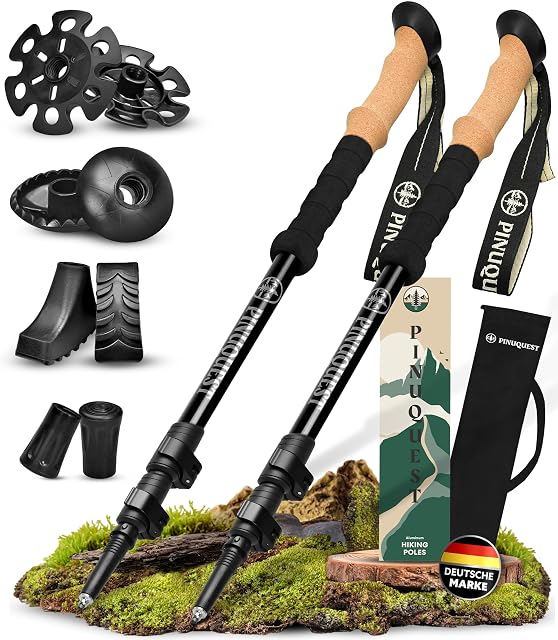
The trekking pole listing publishes 260 g per pole for the aluminium version and 210 g per pole for the carbon one. Publishing both means the upgrade can be costed rather than argued about, and stating the figure explicitly per pole means it can be compared with the rest of that shelf without halving anything. It also publishes a 63 to 135 cm range quoted against user heights of roughly 95 to 200 cm, cork grips with a soft extension below the head, and four pairs of tip attachments — asphalt, terrain, mud and snow — in the box.
The specification the poles will not name
The lock. A telescopic pole is chosen on its lock more than on anything else, and no mechanism is named anywhere on the page: not a lever, not a twist. Nor a packed length, so whether the pair travels inside a case is unknown before they arrive, and no section count, which on a pole reaching down to 63 cm is what explains the range. Three blanks, and they are the three a pole buyer would ask about first.
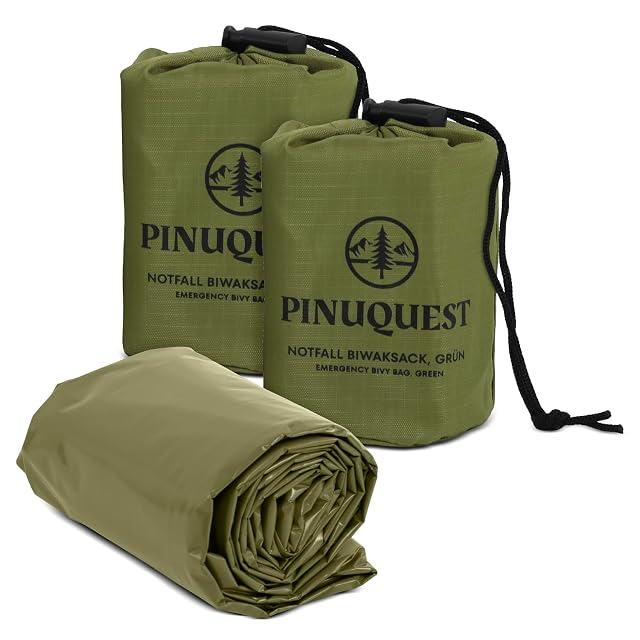
The bivy entry is an emergency bag sold in twos, and the honest reading is that it is not a shelter. It publishes a cut size of 213 by 91 cm and a silvered inner face. Everything else is Not published on the listing: no fabric, no denier, no hydrostatic head, no breathability claim of any kind, no seam taping, no closure, no packed size and no weight — on a product whose whole argument is that it is light and small. The cut size does answer the one question that matters for an emergency sheet, which is whether a body fits inside it. Beyond that, nothing on the page supports treating it as a night out.