The bottom line The cover sheet that publishes its own tolerance and its eyelet spacing, and still gives no waterproof rating and no weight.
What this listing puts on record
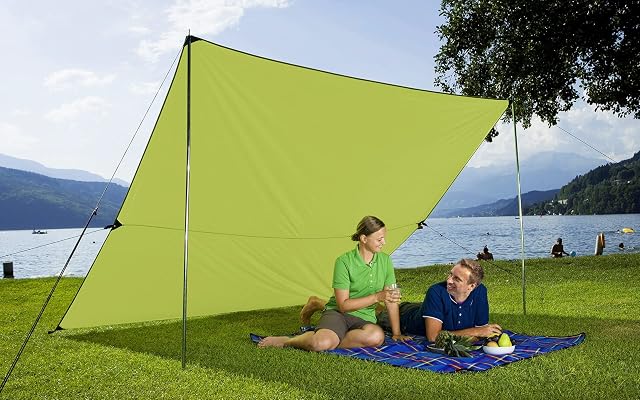
A green woven PP/PE cover sheet, stated at 3 × 3 m and 9 m², at 140 g/m², coated on both sides, UV-stabilised, mould-resistant, washable, with rubber-reinforced corners, double-hemmed edges and aluminium eyelets at 50 cm spacing. All measurements carry a stated ±5% tolerance.
The two figures that decide it
Eyelets at 50 cm. The tightest spacing here, and spacing is the practical figure — it tells you where you can anchor, which the hub intro identifies as the thing a tarp actually is.
±5%. A published dimensional tolerance. Almost nothing in this niche admits to one, and on a sheet bought to fit under something specific, 15 cm on a 3 m edge is worth knowing before rather than after.
What the listing keeps quiet about
No hydrostatic head. Like the other woven sheet here, it is graded by fabric weight rather than by a millimetre figure, so it cannot be compared with the PU-coated camping tarps in this hub.
No sheet weight. 140 g/m² is a fabric weight. What the folded sheet actually weighs is absent.
Nothing in the pack. No lines, no pegs, no poles.
Before ordering
At 140 g/m² this is lighter fabric than the other woven sheet in the hub. Lighter in this class generally means thinner, and the maker publishes nothing else to weigh that against.
Availability
Selling between 16 € and 21 € across the German, French, Italian and Spanish Amazon stores when this page was checked.
It also sells on the British Amazon store in the local currency, which the range above does not cover — that range counts euro stores and nothing else.
Nothing came back from the American Amazon store, so the buy link there opens a local search instead of a page that is not there.
Every figure in this section is what Keepa returned on the day this page was last updated. Prices and offers change without notice.
Prices quoted in this text were read on 6 September 2026. The live price is at the top of the page.
What it does well, and where it gives way
Strengths
Eyelets at 50 cm are the closest spacing here, which is twice as many anchor points per edge as the alternative
Publishes a dimensional tolerance of ±5%, which almost no listing in this niche does at all
States rubber-reinforced corners, double-hemmed edges and a mould-resistant coating
Compromises
No hydrostatic head, so it cannot be compared with the coated camping tarps in this hub
At 140 g/m² the fabric is the lighter of the two woven sheets here, and the sheet weight is still unpublished
Nothing else in the pack — no guylines, no pegs, no poles
Specifications
Shape and cut
Rectangular flat sheet, 3 × 3 m — stated; a general-purpose cover, not a cut camping tarp
Dimensions
3 × 3 m, stated as 9 m², with a stated tolerance of ±5% on all measurements
Fabric and coating
PP/PE woven fabric at 140 g/m², coated on both sides and stated to be UV-stabilised and mould-resistant
Hydrostatic head
Not published on the listing — the sheet is called waterproof, and a weight per square metre is given instead of a millimetre figure
Denier
Not published on the listing — the fabric is quoted by weight, at 140 g/m²
Tie-out count
Not published on the listing — aluminium eyelets at 50 cm spacing are stated, and the total is not given
Tie-out reinforcement
Corners reinforced with rubber edging, and all edges double-hemmed — stated
Weight
Not published on the listing — 140 g/m² is a fabric weight, not the weight of the sheet
What the pack includes
Not published on the listing — no guylines, pegs or poles are listed
Amazon reference
B07HL54WZ7 (same reference on 5 Amazon marketplaces)
EAN
4260313267187
What people ask before buying
Why does eyelet spacing matter more than eyelet count?
Because spacing is what tells you where you can anchor. A 3 m edge with eyelets every 50 cm gives more tie-down positions than the same edge with eyelets every metre, and the hub intro puts the point plainly: each tie-out is a pitch you can improvise. The listing gives the spacing and leaves you to count.
What does the ±5% tolerance mean in practice?
On a 3 m edge it is up to 15 cm either way, and the maker states it up front. That is unusual candour for this class of product, and it matters if the sheet is being bought to fit under a particular tent footprint.
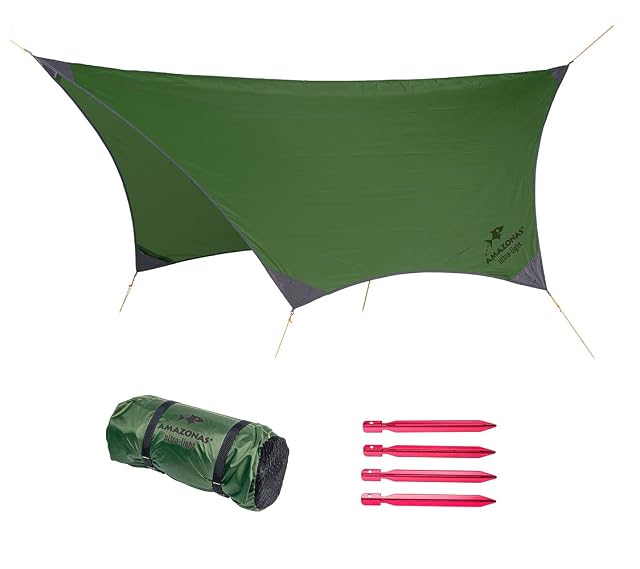
Hammock tarp · 3.40 × 2.80 m · title says ripstop nylon, description says 210T polyester · 0.8 kg in the title, 650 g in the text · 25 × 10 cm packed · bag only
A hammock tarp that contradicts itself twice on the same page — nylon or polyester, 0.8 kg or 650 g — while publishing the smallest packed size in this hub.
Best for: A hammock that needs a roof, where the packed size is the constraint and the contradictions are read first.
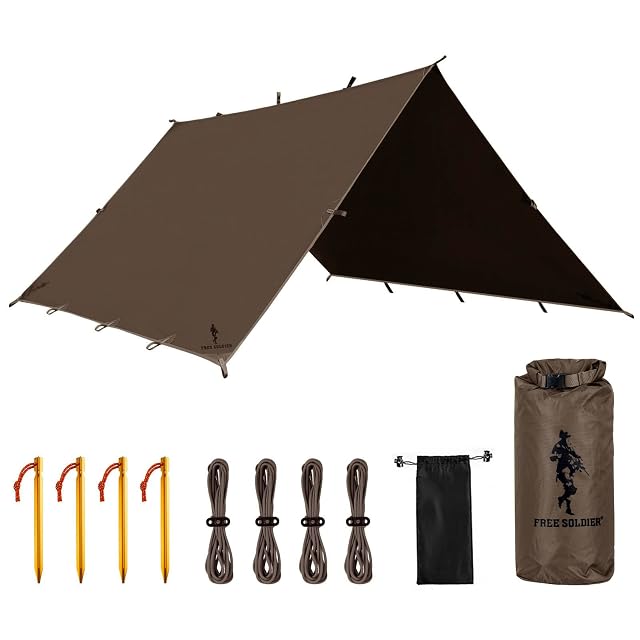
Camping tarp · 300 × 300 cm · 150T ripstop polyester, 3000 PU coating · seam-sealed · webbing-reinforced load points · 1 kg stated · four ropes and four pegs supplied
A 3 × 3 m tarp with a coating figure, sealed seams, webbing at every load point and a stated 1 kg — and no count for the load points it reinforces.
Best for: A square tarp bought complete, where sealed seams and reinforced load points matter more than pack weight.